Portfolio
About
Leif Hetland is a full-stack engineer and instructor who likes untangling complicated systems, whether that's in code, a workflow, or how a team works together. He has spent more than ten years building and shipping web apps across the whole stack, React with TypeScript in the front end, Node, PostgreSQL, and GraphQL in the back end.
Teaching shaped how he works and how he explains things. Presenting hard concepts to hundreds of students, from every background, taught him to break down complexity, say things plainly, and help someone move from uncertainty to confidence. These days a lot of that is AI-native: building, debugging, and reviewing with Claude, GPT, and LangChain in the loop. He is comfortable as the "human in the loop."
Leif is happiest at the intersection of technology and something real, figuring out how the pieces fit, finding where they break, and making them more stable and user friendly.
Technologies
AI
- Claude
- OpenAI API
- LangChain
- Prompt engineering
Languages
- TypeScript
- JavaScript (ES6+)
- SQL
- HTML / CSS / Sass
Frontend
- React
- React Native
- Tailwind CSS
- Vite
- Angular
Backend & data
- Node.js
- PostgreSQL
- Supabase
- GraphQL / Apollo
- KeystoneJS
Auth & security
- JWT
- OAuth
- Row-Level Security
- Firebase Auth
- SSO
Testing & CI/CD
- Jest
- Vitest
- Cypress
- GitHub Actions
- Docker
- TDD
Cloud & tools
- AWS S3
- Vercel
- Render
- Git
- Stripe
- Shopify
- Redesign
- Client: James Williams, LLC
- Metro Atlanta general contractor
- Independent engagement
JAMES WILLIAMS,LLC
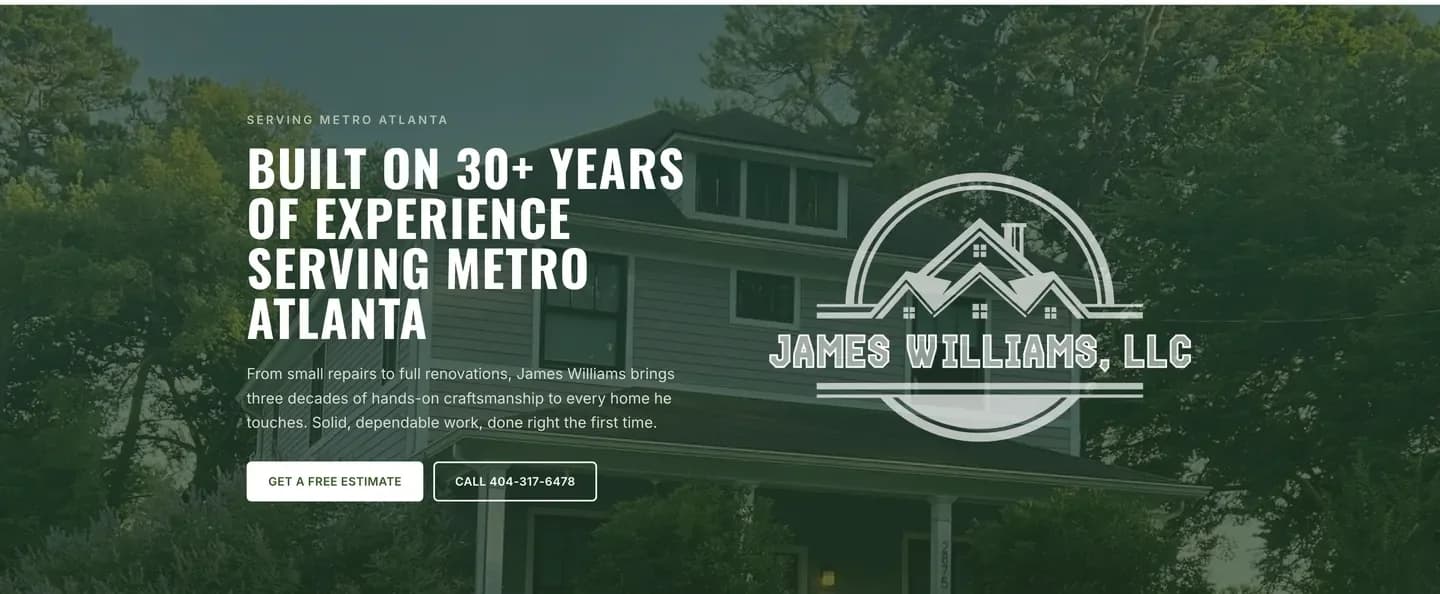
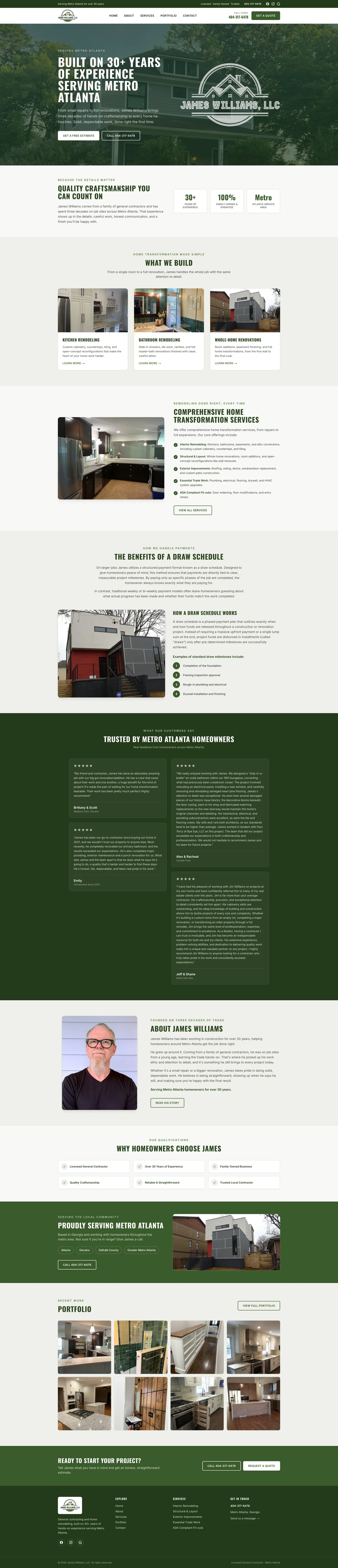
A full redesign for a Metro Atlanta general contractor, told as a before and after: from a bare single-page template to a full marketing site that shows the work properly.
Redesign, 2026, Delivered
James Williams, LLC
A full redesign for a Metro Atlanta general contractor, told as a before and after: from a bare single-page template to a full marketing site that shows the work properly.
The brief
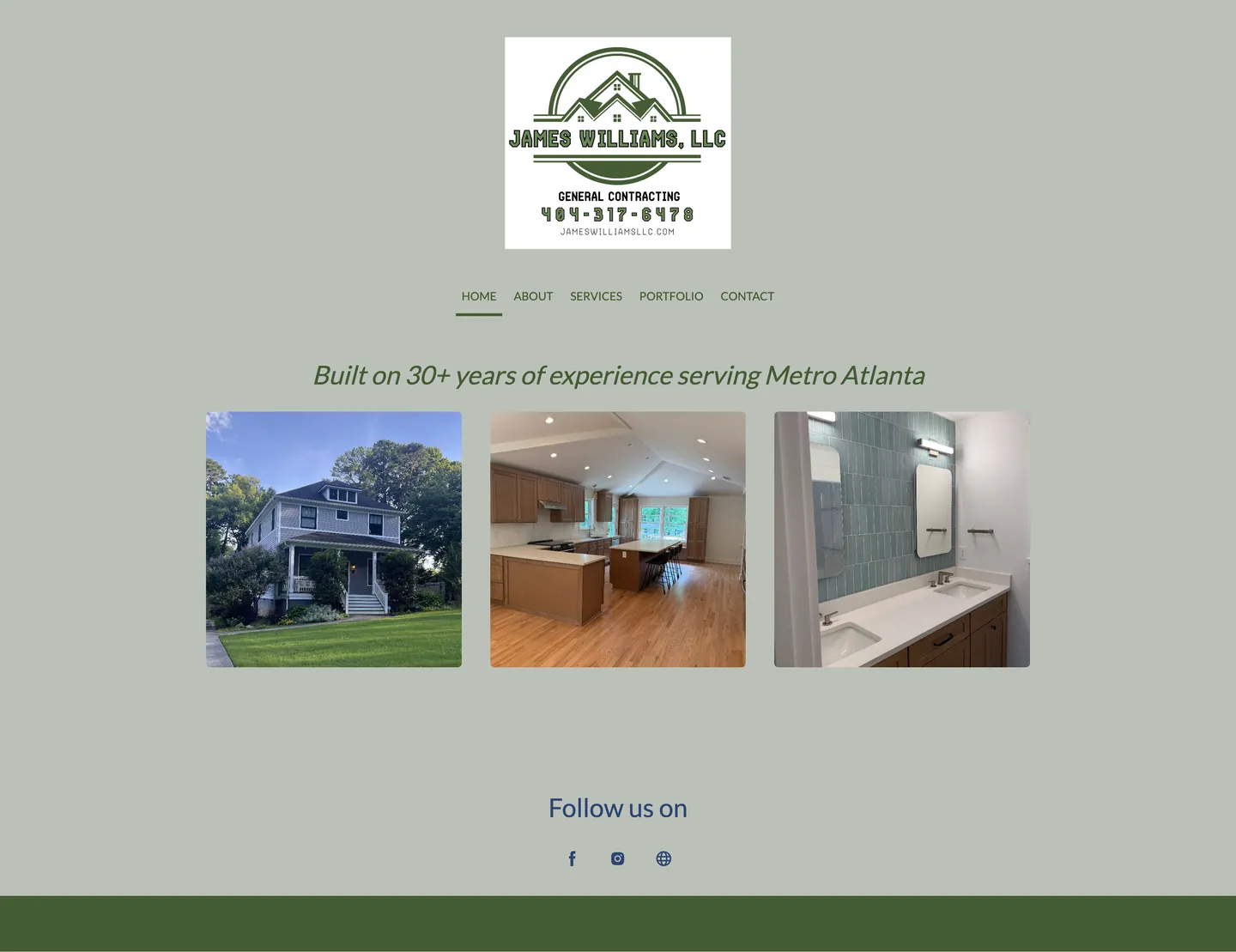
James Williams, LLC is a family-owned Metro Atlanta general contractor with thirty-plus years behind it. The job was a site to match the work: as considered and reliable as the builds Jim and his team deliver.
The after
The redesign is a full marketing site. A hero with clear calls to action, then a credibility band up front: thirty-plus years, family-owned, service area. A services grid opens into a fuller services section, and a draw-schedule explainer walks clients through how construction financing actually pays out, which most contractor sites leave out. Testimonials, the founder's story, qualifications, and a portfolio grid close it out.
Why it leads
This one covers the whole arc of the work: information architecture, content strategy, a small design system, and the build. Drag the divider above to compare.
- Web platform
- Client: Videodrome, Atlanta
- 617 N Highland Ave NE
- Independent engagement
VIDEODROME
A web presence and inventory rebuild for a beloved Atlanta video store, with an engineering story underneath: migrating a legacy desktop database into a modern, searchable catalog.
Web platform, 2026, In progress
Videodrome
A web presence and inventory rebuild for a beloved Atlanta video store, with an engineering story underneath: migrating a legacy desktop database into a modern, searchable catalog.
01 / 05
The brief
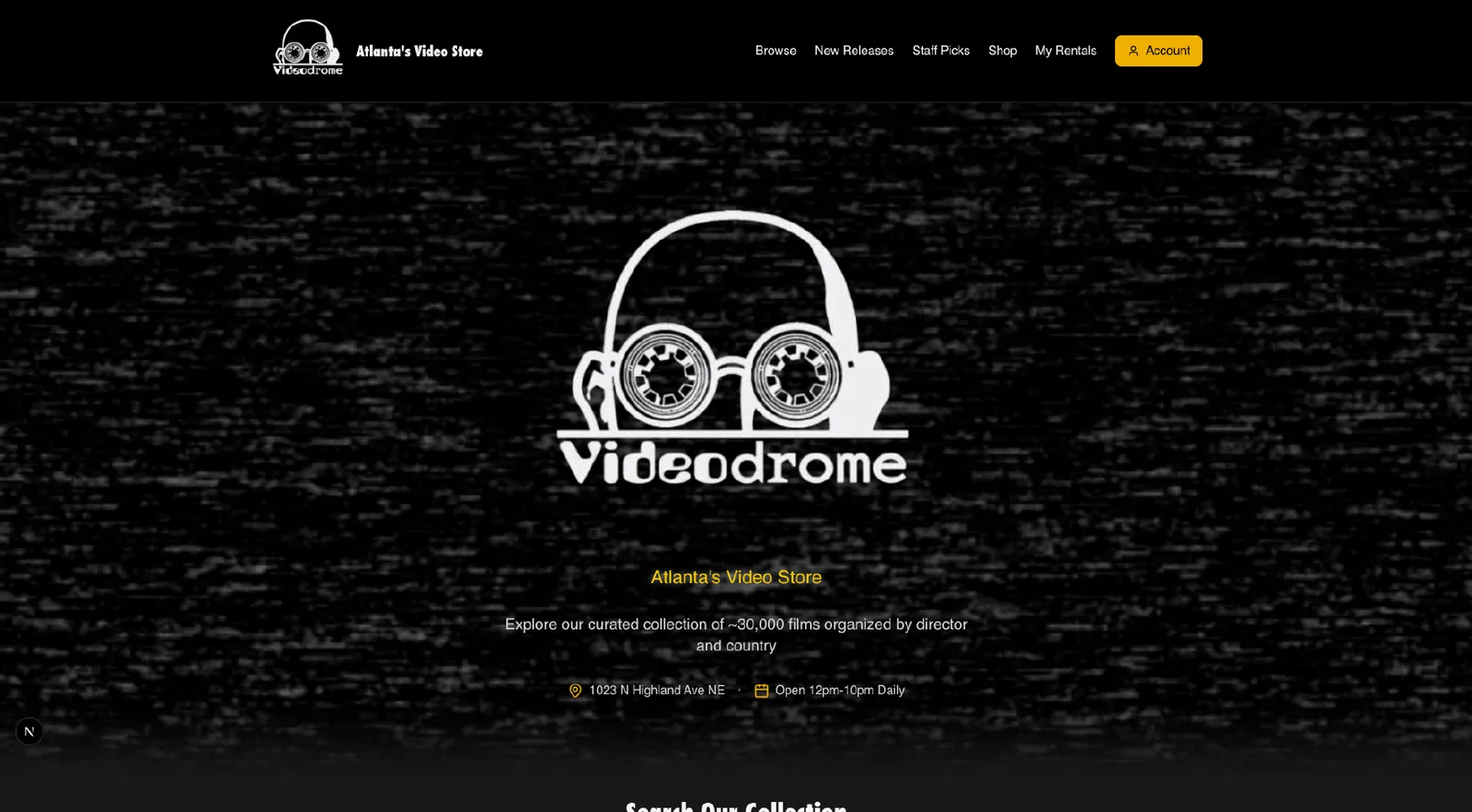
Videodrome is an Atlanta video store with a catalog streaming cannot match: about thirty thousand titles, shelved by director and country instead of by algorithm. The job was a web presence worthy of the shelves and an inventory the staff could actually run.
The hard part
The data lived in a legacy Clarion desktop database, a closed decades-old system never meant to touch the web. The storefront was the easy part. The real work was getting thirty thousand records out without losing the hand-built organization that makes the store what it is, then modeling them in PostgreSQL to support search by title, director, and country, plus live rental availability.
The build
The front end is a TypeScript and Next.js storefront over that Postgres catalog: fast search, filters for availability and genre, and film cards showing poster, director, year, and copies left. One data model feeds both the site and the point-of-sale, so the counter and the web read from a single source of truth instead of two systems drifting apart. The look is editorial and dark, on a small design system that keeps new sections consistent as the catalog grows.
Where it stands
The design and data model are built. The rebuild is in development, not yet live on the store's domain. The screens here are from the working design. Next is the migration tooling and the staff-facing inventory views.
- Web platform
- Client: Bon House, Decatur
- 150-cap room, PBR sponsorship
- Independent engagement
BON HOUSE
A web presence with the energy of the room: a collage build for a 150-cap DIY music venue in Decatur, PBR-sponsored, live and growing. Built for the venue to keep current day to day.
Web platform, 2025, Live
Bon House
A web presence with the energy of the room: a collage build for a 150-cap DIY music venue in Decatur, PBR-sponsored, live and growing. Built for the venue to keep current day to day.
01 / 02
The brief
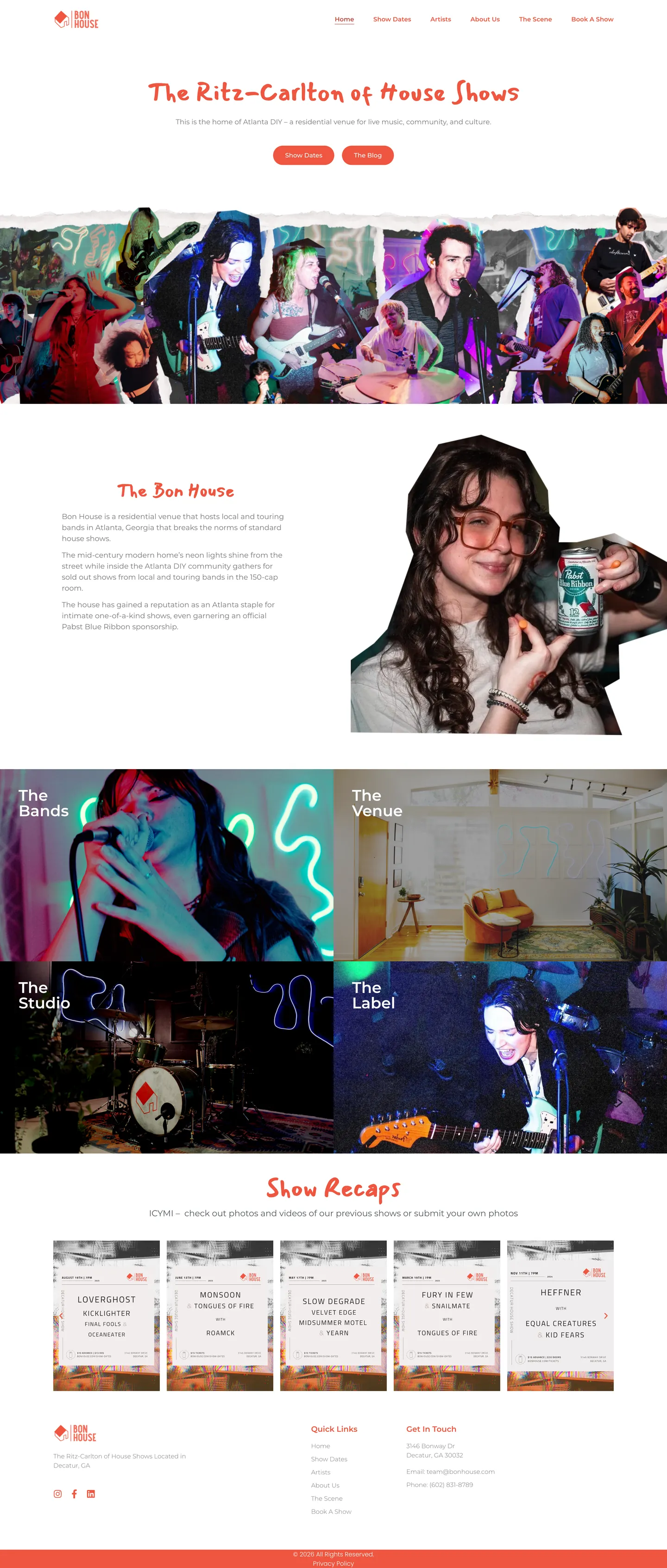
Bon House is a DIY music venue in Decatur: a 150-cap room with a PBR sponsorship and a growing crowd. It needed a site with the energy of the room, not another quiet minimal template.
The build
The site is built on a collage aesthetic that matches the space: brush display type, a torn-paper photo hero, and one grid that holds the whole operation, the bands, the venue, the studio, the label. It runs on WordPress, so the crew can post shows and update sections themselves without the layout drifting.
Why it belongs here
Next to the contractor and video-store work, Bon House shows range: a completely different look over the same system discipline. It is a client engagement, so the site is shown as built, with individual band photos kept to where the agreements allow.
- Curriculum engineering
- Georgia Tech full-stack flex program
- Delivered through the 2U/edX network
- 15+ students per cohort
HIGHER-ED PROGRAMENGINEERING
Six years teaching the full-stack bootcamp, then re-engineering the curriculum behind it: the 2U/edX program taught in partnership with universities like Georgia Tech, SMU, and UPenn. A syllabus rebuilt as a system, made to run at scale.
Curriculum engineering, 2018 to 2024, Concluded
Higher-ed Program Engineering
Six years teaching the full-stack bootcamp, then re-engineering the curriculum behind it: the 2U/edX program taught in partnership with universities like Georgia Tech, SMU, and UPenn. A syllabus rebuilt as a system, made to run at scale.
The brief
For six years Leif taught the full-stack bootcamp, the 2U/edX curriculum delivered in partnership with universities like Georgia Tech, in cohorts of thirty to fifty. The more interesting job came later: curriculum engineer on a full overhaul of that program, treating the curriculum as a system with inputs, feedback, and outcomes rather than a fixed syllabus.
The overhaul
It modernized the whole stack a student moves through: AI and LangChain added, core material moved to TypeScript, CI/CD and test-driven development made habits instead of topics, and a Python module built in. The goal was a path from day one to a shippable project that stays tested, current, and repeatable across instructors and cohorts.
The scale
The curriculum ran through the 2U/edX bootcamp network, taught in partnership with universities like SMU and UPenn, so the same work reached programs well beyond a single campus. That reach is the point: not one classroom but a learning system, built to keep working when many different people run it. The curriculum belongs to 2U/edX and its university partners. Leif was one of a small team doing the engineering that made it run at scale.
- Film, games, and score
- With collaborators, incl. Tyler Aldridge
- Atlanta Film Society PA Academy, 2025
- Wider body of work on request
CREATIVEPRACTICE
The maker throughline: games built with a longtime collaborator, original music for a fifty-episode podcast, and short films written, shot, and scored. One practice, many media, engineering underneath.
Film, games, and score, 2015 to now, Ongoing
Creative Practice
The maker throughline: games built with a longtime collaborator, original music for a fifty-episode podcast, and short films written, shot, and scored. One practice, many media, engineering underneath.
The throughline
It started with video games. In college, building them was the door into software engineering, and film and music have run alongside the code ever since. One practice across media: Leif writes, shoots, edits, and scores the same way he builds software, with the same instinct for structure and pacing.
Film
Two shorts of his own: "The Traveller" (co-writer, cinematographer, composer, editor) and "Lights Among Us" (co-writer, 1st AD and set support, editor). Around them, on-set craft on other people's projects: 1st AD, PA, boom operator, camera operator, and grip, including the feature "Content" (grip, camera and electrical, 2019). Atlanta Film Society PA Academy trained, 2025.
Games
Punchy Fox was the studio attempt, built with his longtime collaborator Tyler Aldridge, and it reached a playable prototype. The jams around it taught scope and finish: "Is Anyone Out There?" did well at its jam, and "La Bomba," a Bomberman-style clone, got to a playable build.
Score
Original score and theme music for the "Holed Up" podcast series, fifty episodes across 2024 and 2025, plus scores for his own films.
Why it belongs here
For Leif, filmmaking, game development, music production, and software are one pursuit, and creativity runs through all of it. The instincts hold across every one: structure, pacing, and the discipline of finishing. It also points to a wider body of work: experimental music, digital art, and film. Clips, game footage, and score samples are available on request.
- Agency and freelance
- 40AU, Horton Group, and independent
- Healthcare and bank work under confidentiality
- Live sites listed below
CLIENT WORKAT SCALE
The breadth-and-reliability story: agency years at 40AU, a reusable client platform for Horton Group, and a run of independent builds that are still live and still maintained.
Agency and freelance, 2016 to now, Ongoing
Client Work at Scale
The breadth-and-reliability story: agency years at 40AU, a reusable client platform for Horton Group, and a run of independent builds that are still live and still maintained.
The shape of it
A decade of client work, shipped and maintained. The point is breadth and reliability: a lot of it went live and stayed live.
Agency: 40AU
At 40AU Leif maintained the brand sites for four 4Top Hospitality concepts, an employee-owned restaurant group across the Southeast: etc., etch, Amerigo, and Char in Nashville. All four are still live, largely as he set them up. Alongside them ran work that stays credit-only: the home site for Vanderbilt's "My Day" diabetes-tracking app, a stint on the NARUS "Compassion" nursing dashboard, brand work through Fullscreen Direct (Megadeth, Eric Church, Kid Rock, Linkin Park), and bank web forms and stored procedures. Healthcare and bank work he can name but not show, under NDA.
Platform: Horton Group
With Horton Group's senior developer, Leif built a reusable templated app on Angular and KeystoneJS, designed so the team could re-skin it for new clients instead of rebuilding each time. The real decisions were the seams: what to make configurable, what to keep fixed, how one codebase serves many client skins without forking. He also handled remediation, pulling a bloated WordPress site (Sisters on the Fly) back to something maintainable.
Independent
Freelance builds Leif designed, built, onboarded, and maintained: TNPRCV, Rebuilding Together Nashville, Foundation Christian Academy, and Sombra Mexican Kitchen. Small engagements, full ownership, still standing.
If you're working on something exciting or challenging and want someone who can both build it and explain it, please reach out.
Built with Next.js, TypeScript, and Tailwind. Type set in Archivo, Orbitron, and JetBrains Mono.